

Know which machine is free, and what each hire actually earned.
Availability, deposits, damage, delivery and service dates in one hire file. Built for companies that rent plant, tools and access equipment.
01 / 06
We understand the week
How an equipment hire actually runs
Eight steps. The money usually slips in the gaps between them.
- 01
Enquiry
Where it breaks
Dates, the site and the machine live in a phone note.
What changes
One hire record: customer, dates, site and the machine they asked for.
- 02
Availability
Where it breaks
The same excavator is promised from two counters.
What changes
The quote only offers units that are free, including ones already out.
- 03
Contract
Where it breaks
The deposit or the damage waiver is skipped when the yard is busy.
What changes
Contract, deposit and damage waiver are on the hire before it leaves.
- 04
Prep
Where it breaks
A unit with an overdue service still goes on the truck.
What changes
A due service blocks the next booking.
- 05
Delivery
Where it breaks
Nobody records which serial number left, or where it was dropped.
What changes
Scan out, then the delivery address on the same hire.
- 06
On hire
Where it breaks
The customer keeps it two extra days. The invoice still says the original dates.
What changes
An extension changes the end date and the charge.
- 07
Return
Where it breaks
A scratch is noticed later, with no photo from the dock.
What changes
Photos and a damage line while the unit is still in the bay.
- 08
Invoice
Where it breaks
Days, damage and a service hold are reconciled in a spreadsheet.
What changes
Bill from the hire file, then put the unit back only when it is ready.
The problems
What equipment hire companies lose money on
The yard and the desk disagree
Inventory, maintenance and payments often sit in different tools. Staff still phone around to see if a machine is free.
Quipli’s 2025 rental tech survey: 16% of operators said their systems were fully integrated. 67% were partly integrated and still moved data by hand.
A lot of the fleet is not earning
Demand is not the only limit. Units sit in the yard, or in the workshop, while the counter still takes bookings for categories that are already out.
Klipboard’s March 2026 UK and Ireland hire benchmarks: more than half of construction plant and tool operators were below 70% utilisation. 16% were above 80%.
Damage never becomes a charge
If the return check is a glance, the scratch is found on the next customer. The first hire was never billed for it.
The same Klipboard benchmarks: 39% of operators named unbilled damage as a leading source of revenue leakage.
The hire runs longer than the paper
A verbal extension is normal on site. If the end date does not change, you give away days or argue about them later.
Klipboard: one in three hire businesses said miscommunication about rental duration leads to lost revenue.
Service takes machines off the board
A unit in the workshop is not available, even if the sales screen still shows it. Parts and a missed inspection stretch that gap.
Klipboard: 37% of construction hire businesses said up to 20% of inventory can be out of service at once. Only 12% said their systems help prevent avoidable breakdowns.
Growth is slower, so leaks matter more
When the market is not expanding fast, a double booking or an unbilled week is harder to hide inside new revenue.
American Rental Association, November 2025 outlook: US equipment and general tool rental revenue of $80.5 billion in 2025, then $82.3 billion in 2026. Construction and industrial equipment was about $63.4 billion of the 2025 figure.
These are published industry surveys and benchmarks, not audited accounts of a named company. Your yard will differ. Plant, tools and access equipment are the focus. Event AV, lighting and staging have their own page, because crew and sub-rental dominate that work.
The solution
One hire file. Six places it has to be right.
Sample screens with demo data, not a live client result.
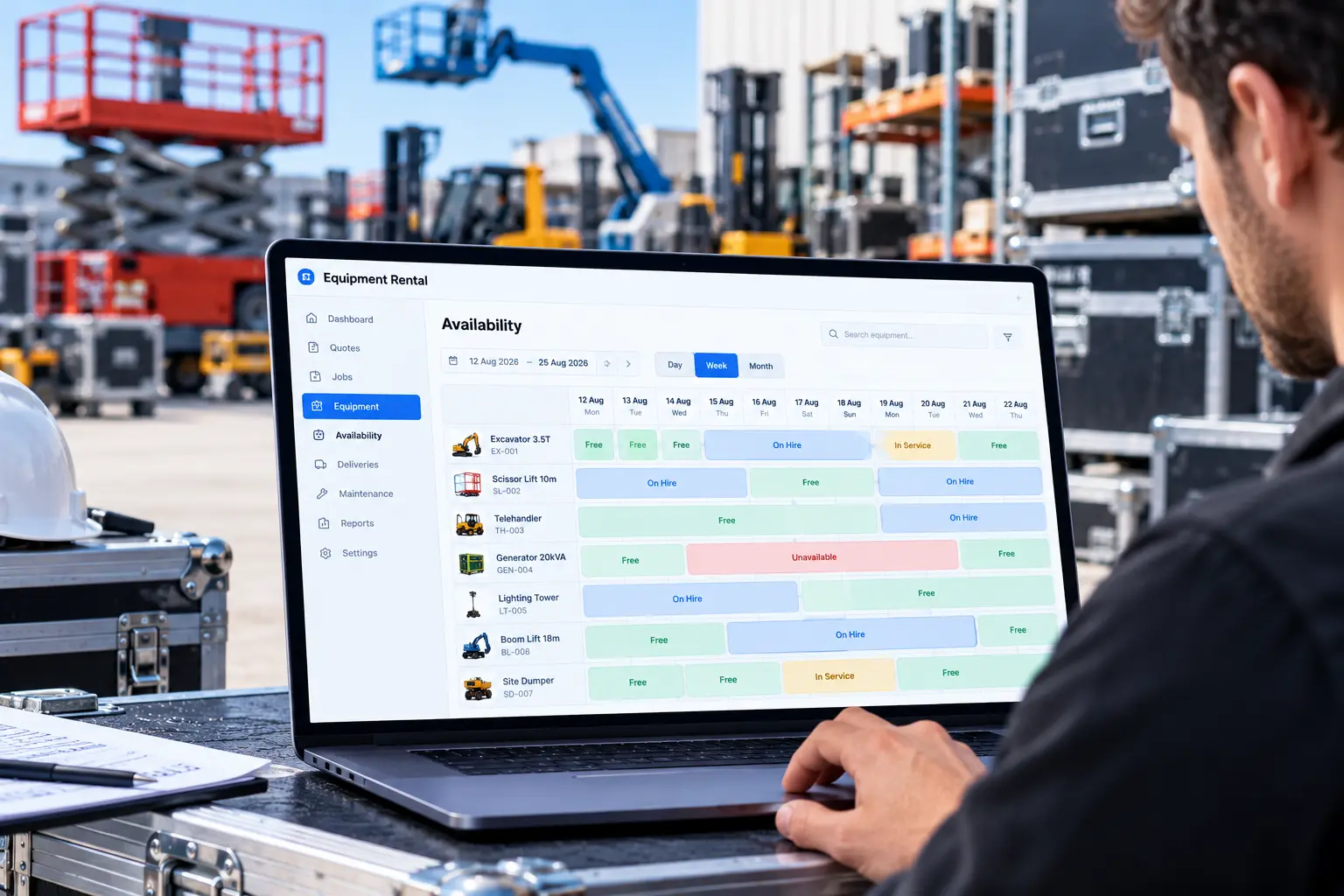
Availability across the yard
Do not promise a machine that is already on hire.
The quote is built from dates. Each unit shows whether it is free, out, or in the workshop. A second counter sees the same board.
- Free, on hire, or in service for those dates
- One board for every counter and yard
- Shortages visible before you confirm
Research: Quipli reported that seven in ten rental companies lose time to inefficient processes, and that most run three or four disconnected systems. The double booking usually starts in that gap.
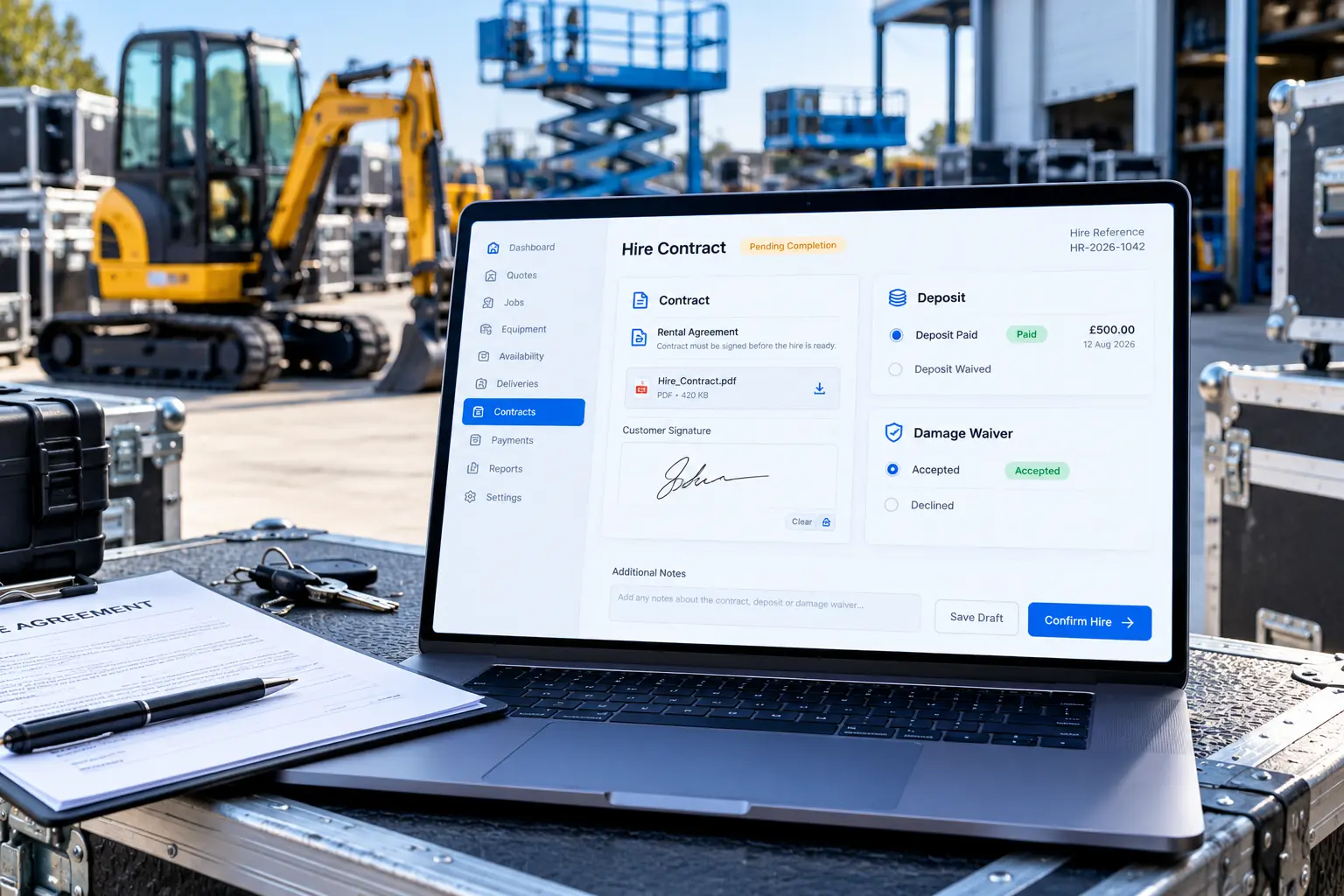
Contract, deposit and damage waiver
The paperwork is done before the machine moves.
The hire cannot be marked ready until the contract, the deposit and the damage waiver are recorded. Busy Saturdays do not skip the step.
- Contract on the hire record
- Deposit taken or marked as waived
- Damage waiver accepted or declined
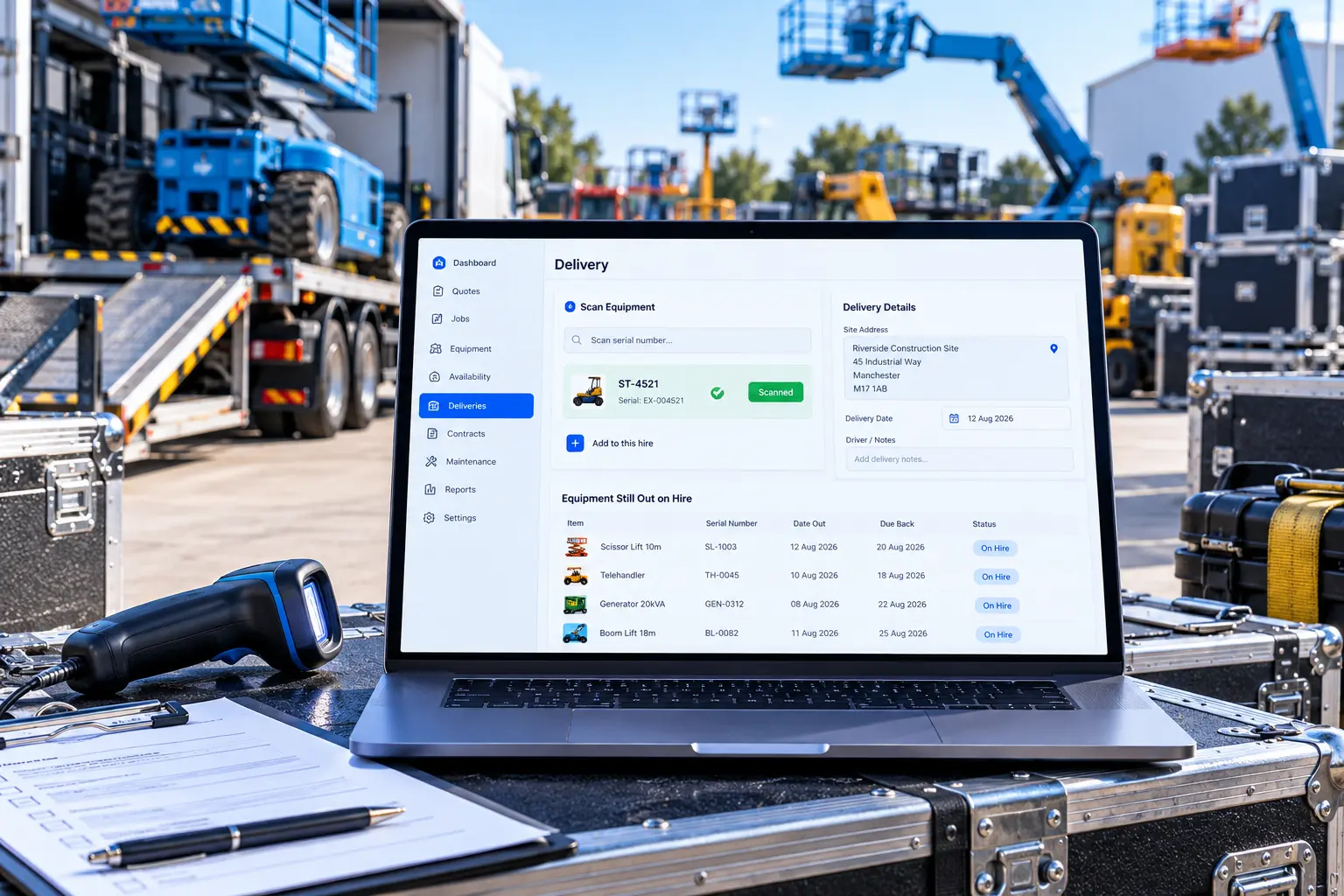
Scan out, then deliver
The serial number that left is the one on the hire.
Yard staff scan the unit onto the hire. Delivery keeps the site address on the same record, so the office is not guessing which machine went where.
- Scan the unit before it loads
- Delivery address on the hire
- A list of what is still out
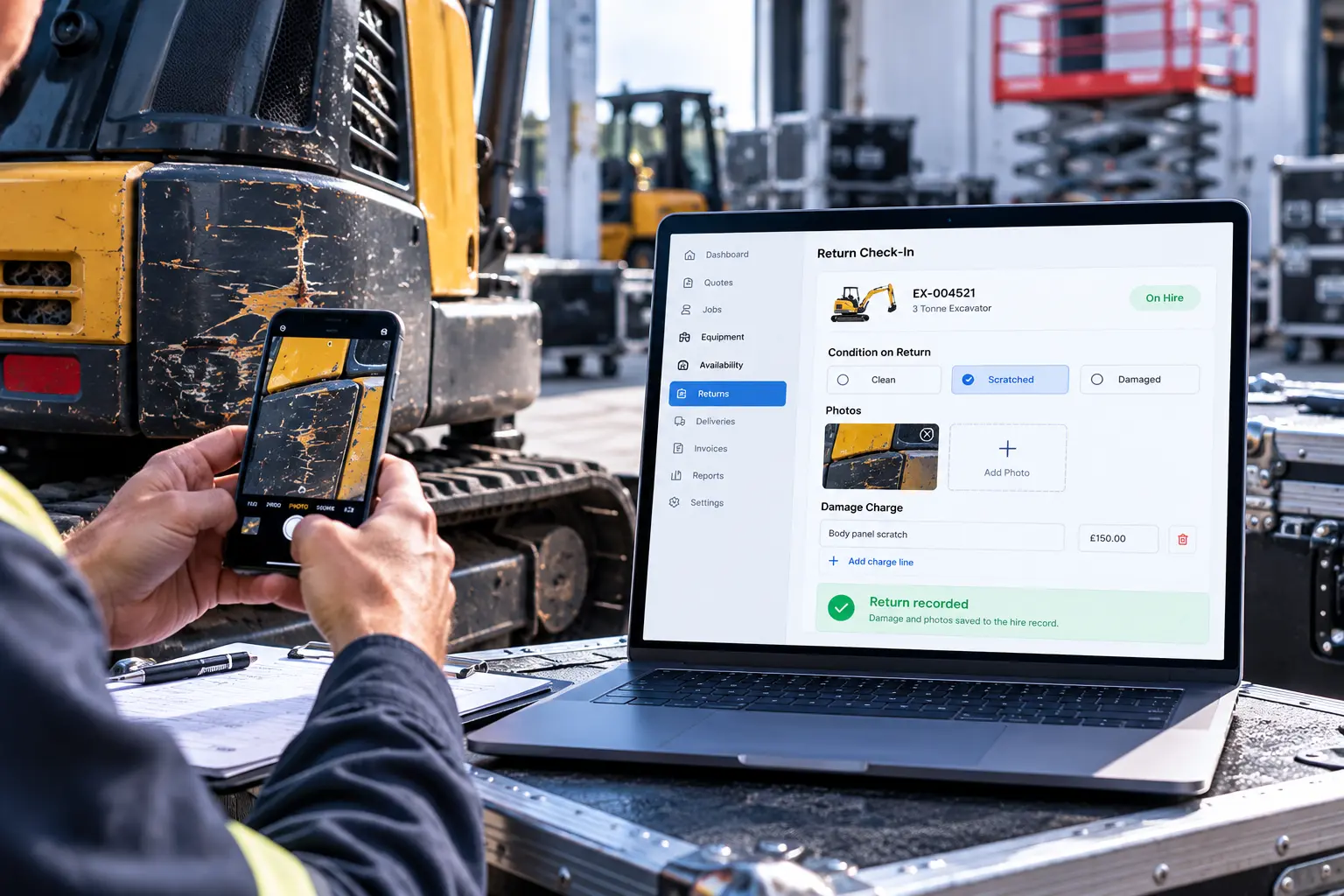
Return with a photo
A scratch becomes a line while the customer is still in the system.
Check-in asks for photos of damage. The charge sits on the hire before the invoice is sent, instead of turning up on the next customer’s complaint.
- Photos at the dock
- Damage as a charge line
- Clean returns close without a debate
Research: Klipboard’s 2026 benchmarks named unbilled damage as a leading leak for 39% of operators. The photo has to exist at return, not in someone’s memory.
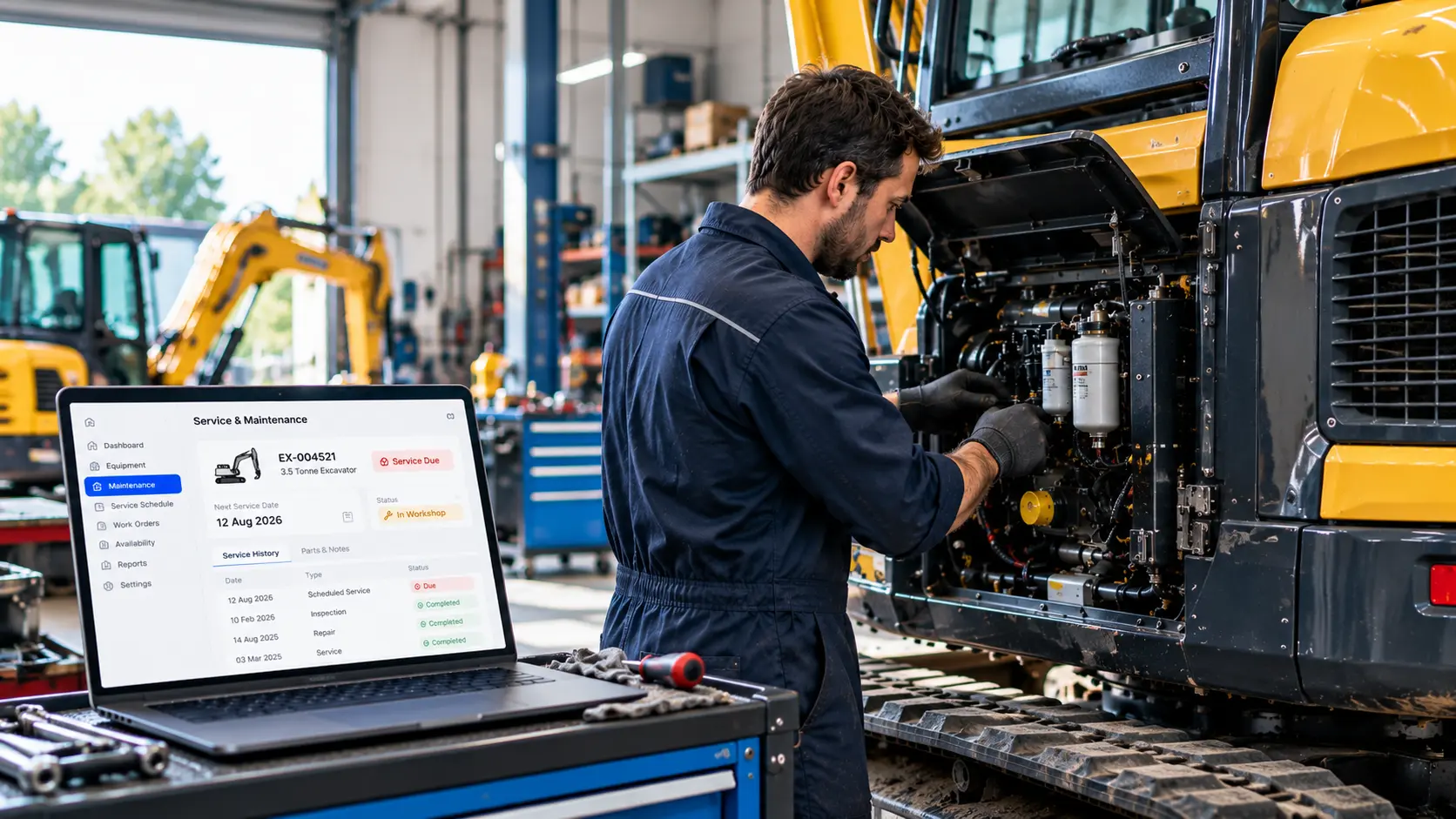
Service due blocks the next hire
A unit in the workshop is not available.
Each machine has a next service date. When it is due, or when return shows a fault, the unit drops off the availability board until the workshop clears it.
- Next service date on the asset
- Blocked from the next booking when due
- Workshop and the counter share one status
Research: Klipboard found 37% of construction hire businesses can have up to 20% of inventory out of service at a time, for inspections, maintenance or repairs. If that status is invisible, the counter still sells it.
What the fleet actually does
On hire, in the yard, in service, or idle.
Owners see which categories earn and which sit. Idle plant is a buying decision, not a feeling at the end of the month.
- Status of the fleet this week
- Utilisation by category
- A reason to buy, sell or stop hiring a class of machine

What research says
Numbers we can actually stand behind
- Industry survey
16%
of rental operators in that survey said their systems were fully integrated. Most still move availability, maintenance and payments by hand.
Quipli, 2025 State of Tech in the Equipment Rental Industry
- UK & Ireland
39%
of operators named unbilled damage as a leading source of revenue leakage.
Klipboard Rental Benchmarks, March 2026, UK and Ireland construction and access hire
- UK & Ireland
Below 70%
utilisation for more than half of the construction plant and tool operators in the same benchmarks. Only 16% were above 80%.
Klipboard Rental Benchmarks, March 2026
Start small
You do not have to replace the whole hire system on day one
- 1
Start: a shared availability board
- 2
Next: contract, deposit and damage waiver on the hire
- 3
Then: scan out, return photos, and service blocks
Pilot
Pilot starting: we are looking for two hire companies
Plant, tools or access equipment. We will put one availability board in place, or photos on return, and measure one real month with you.
Join the pilotGetting started
How we start
- 1
30-minute call
You walk us through the last three hires, from the call to the invoice.
- 2
We map the leaks
Where the counter, the yard and the workshop stop agreeing.
- 3
Small pilot
One part first. Usually the availability board, or photos on return.
- 4
Roll out
Deposits, delivery and service blocks follow once the first loop is trusted.
FAQ
Questions hire owners ask
Yes. Scan-out, delivery and return photos are meant for a phone or a tablet, not only the office desktop.
No. We can start with one loop, such as a shared availability board, and leave the rest of your tools in place while you try it.
The hire records the deposit and whether a damage waiver was accepted. On return, photos can become a charge line before you invoice.
You do. Assets, hires and customers stay yours.
We set invoices for the country you bill in. Tell us the rules on the first call so they are in scope.
Yes. The people who load machines and the people who take bookings both get a walkthrough of the part they use.
Let's look at your last three hires.
30 minutes. No pitch deck. We follow one machine from the booking to the invoice and mark where the days or the damage were missed.
Book a 30-minute call